


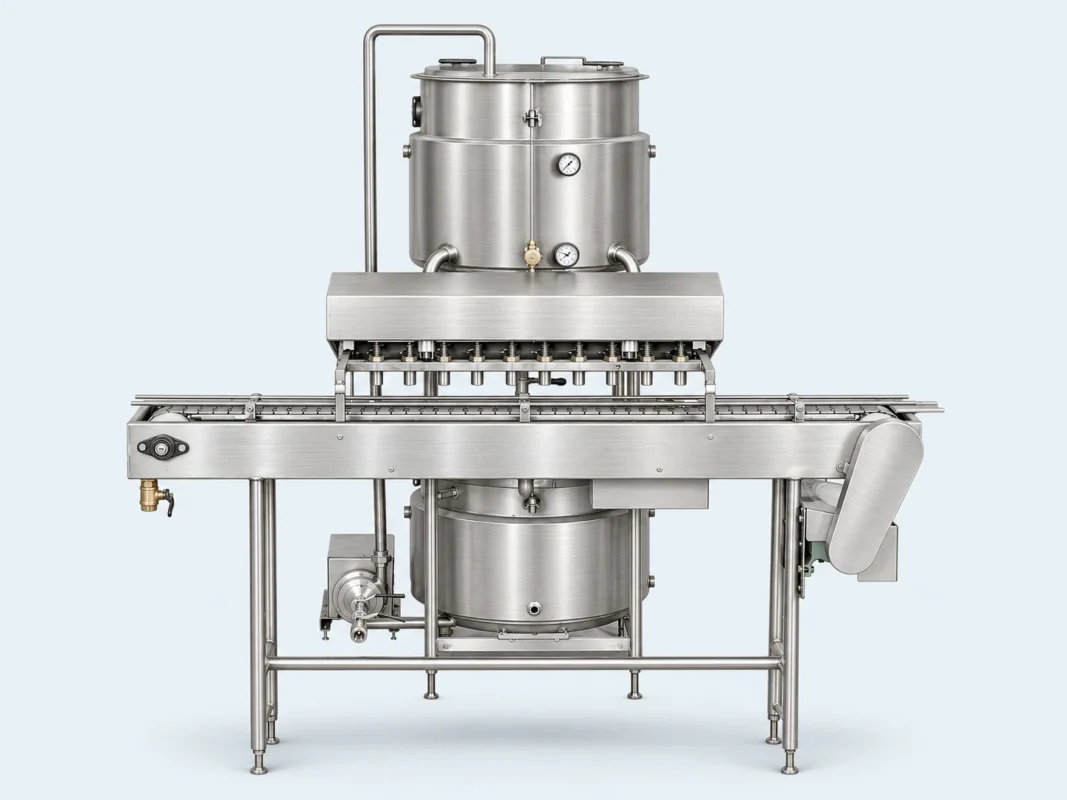
The choice between semi-automatic and fully automatic production affects how cooking, product transfer, filling and thermal processing are coordinated. It should follow the production plan and available operating resources.
Compare the actual operator tasks
In a semi-automatic arrangement, operators may load cooking vessels, transfer product to the filler or arrange cartons. In a fully automatic configuration, the flow from soaked-legume transfer through filling, sauce addition, seaming and transfer to the retort is more closely coordinated. Ask for a clear description of each manual task; the word automatic alone does not explain the scope of a complete line.
Focus on texture and fill consistency
The supplied description identifies thermal and weight control as important differences. Cooking conditions affect the uniformity of legume texture, while controlled filling helps maintain the intended relationship between solids and sauce. Automation can help keep temperature, cooking time and fill weight consistent at higher volumes. The selected controls still need correct settings, monitoring and operators who understand the process.
Assess flexibility and supervision
Semi-automatic production generally offers a lower initial investment and operational flexibility, with greater dependence on continuous supervision. It can suit a product plan that changes frequently or a factory starting at a smaller scale. More automation can support coordinated flow and reduce waste or interruptions, but its benefits depend on the whole line, including preparation and retort handling. A fast filling machine does not remove downstream limitations.
Choose for the factory you can operate
Compare staffing, skills, maintenance support, utilities and expected utilisation as well as equipment price. The Liniea line specification gives a workforce range of 6–12 depending on automation; the final working arrangement must be agreed for the actual configuration. Record training needs and how the line should respond to a stop or changeover. The appropriate solution is the one that maintains the required output and quality under the factory’s real operating conditions.
Planning checklist
- Manual loading, transfer and packing tasks
- Temperature, cooking-time and fill controls
- Expected output and changeovers
- Training, maintenance and future automation options
Plan your canned beans production project
Review the Liniea canned beans and legumes production line for the process stages, six main machines, planning specifications and setup questions. Contact the Liniea team to discuss your products, capacity and site requirements.
