


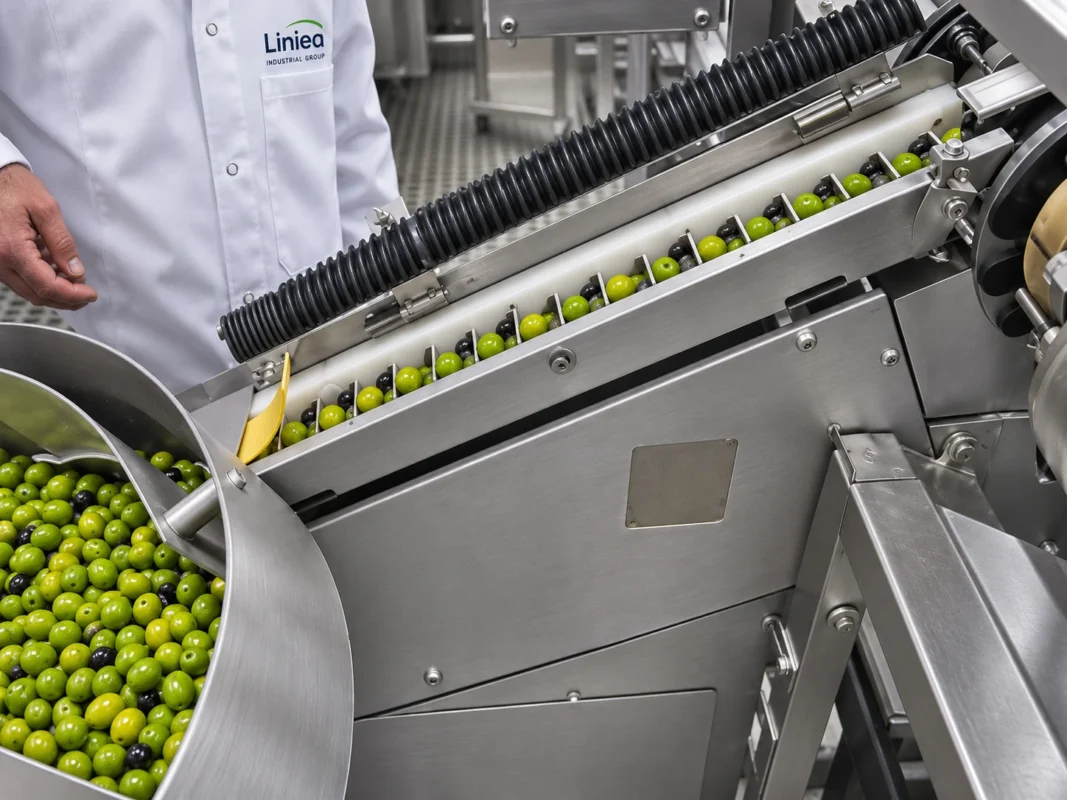
Compare operator involvement in pitting, filling, covering-liquid dosing and closing before choosing automation.
Describe the actual division of work
The main distinction between semi-automatic and fully automatic olive lines is operator involvement, particularly in pitting, filling and packaging. Broad labels do not explain who feeds each machine, moves containers or checks output. Specify these duties stage by stage when comparing configurations. The supplied workforce reference is 3–8 people depending on automation; confirm the exact scope before planning staffing.
Understand the integrated configuration
In a fully automatic arrangement, olive transfer, pitting, even distribution into containers, covering-liquid addition and closing operate continuously under controlled conditions. These stages must exchange product at compatible rates. Automation at one machine does not automatically integrate the equipment before and after it. Review the transfer points, container handling and required operator access as part of the complete system.
Assess operator-assisted production
Semi-automatic lines use manual work for selected duties such as feeding equipment or arranging containers. This can provide flexibility but makes consistency and throughput more dependent on operator organisation. Identify repetitive handling, cleaning and changeover tasks before selecting the arrangement. Training and clear operating instructions remain important for either automation level.
Choose a route that can develop
Select automation around product variety, realistic output, available labour and future expansion. The modular source concept allows filler upgrades, additional pitting capacity and conveyor changes. Confirm that utilities, floor space and machine interfaces support the planned next stage. Liniea can coordinate the initial scope and later improvements so the factory develops as one production system.
Explore the Liniea table olive production line or discuss your factory requirements.
